
String Inverter vs Microinverter vs Hybrid: Which Solar Setup Is Right for You?
Panels capture sunlight; inverters turn it into usable power. Compare string, microinverter, and hybrid battery-ready systems — and learn which fits your roof and budget in 2026.
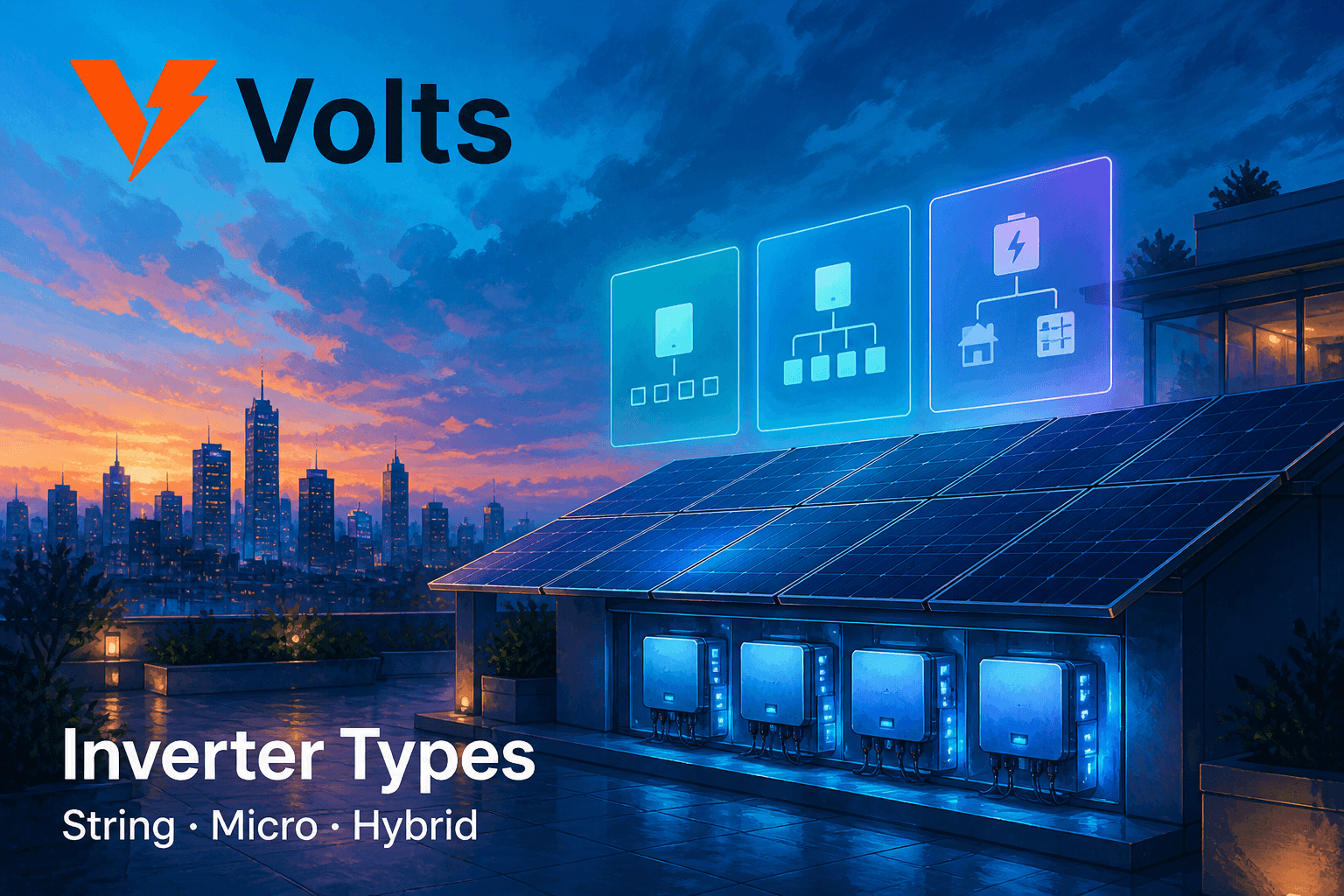
Every solar quote mentions an inverter — the brain that converts DC power from panels into AC for your home and grid. In 2026, three architectures dominate residential installs:
- String inverter — one central unit, panels wired in series
- Microinverters — small inverter under each panel
- Hybrid inverter — string-style unit ready for battery DC coupling
Choosing wrong can mean shade losses, upgrade dead-ends, or thousands extra you did not need.
Key takeaway: String is cost-effective on simple, unshaded roofs. Microinverters win on partial shade and complex layouts. Hybrid makes sense when you are committing to a battery within a few years.
How inverters fit in the system
Solar panels (DC) → Inverter (DC→AC) → Home + grid
Battery systems add a parallel path:
Panels → Hybrid inverter ↔ Battery (DC) → Home + grid
Efficiency, monitoring granularity, and failure modes differ by type.
String inverter — best value on clean roofs
How it works: Panels connect in one or two "strings" to a wall-mounted inverter.
| Pros | Cons |
|---|---|
| Lowest cost per watt | One shaded panel can drag whole string |
| Simple servicing — one box | Single point of failure |
| Mature, efficient tech | Adding battery often needs separate inverter later |
Ideal for: Large unshaded south/north-facing roofs, budget-conscious installs, utility-scale residential where MPPT optimisers are not needed.
2026 price impact: Often $800–$2,000 less than microinverter systems on 8 kW jobs.
Microinverters — panel-level optimisation
How it works: Each panel (or pair) has its own inverter on the rail.
| Pros | Cons |
|---|---|
| Shade on one panel does not kill the array | Higher upfront cost |
| Panel-level monitoring in app | More rooftop electronics |
| Easier expansion module-by-module | More devices that could fail over 25 years |
Ideal for: Complex roof planes, chimneys and dormers, partial shading from trees you cannot remove.
Leading brands include Enphase, APsystems, and others — confirm local warranty support.
Power optimisers — the middle ground
DC optimisers on each panel feed a central string inverter (SolarEdge-style). You get shade tolerance with slightly lower cost than full microinverters. Treat as a string+ category when comparing quotes.
Hybrid inverter — future-proof for batteries
How it works: Combined solar + battery inverter in one unit; stores excess DC in a compatible battery.
| Pros | Cons |
|---|---|
| Clean battery add without second inverter | Premium over basic string |
| Backup power possible with right switchgear | Battery cost still dominates economics |
| One app for solar + storage | Not all batteries work with all hybrids |
Ideal for: Homeowners planning battery within 1–3 years, time-of-use tariffs, or weak export rates (e.g. post-NEM 3.0 California, evening peak pricing in Australia).
Do not buy hybrid "just in case" if battery payback is uncertain — you can add AC-coupled battery later on many string systems.
Quick decision guide
| Your situation | Likely best fit |
|---|---|
| Simple roof, no shade, tight budget | String inverter |
| Shade, multiple roof angles | Microinverters or optimisers |
| Battery planned soon | Hybrid + compatible battery |
| Renting inverter replacement risk | String (cheaper swap) or micro (partial failure only) |
Efficiency marketing vs real-world yield
Lab efficiency differences between top inverters are small. What moves annual kWh is:
- Correct string design and tilt
- Shade management
- Dirt, soiling, and downtime
Ask installers for estimated production (kWh/year) per design — not inverter marketing brochures alone.
Warranty and replacement planning
| Component | Typical warranty |
|---|---|
| String / hybrid inverter | 10–12 years standard; extensions available |
| Microinverter | Often 20–25 years |
| Battery | 10 years / cycle limits |
Budget one inverter replacement over 25 years on string systems (~year 12–15). Factor that into lifetime savings.
AC-coupled vs DC-coupled batteries
DC-coupled (hybrid): Battery connects on DC side of hybrid inverter — efficient for charging from solar.
AC-coupled: Separate battery inverter connects to your panel — easier retrofit on existing string systems.
Retrofitters with existing solar often choose AC-coupled (e.g. Tesla Powerwall on AC) to avoid replacing a working string inverter.
Monitoring and app experience
| Architecture | Monitoring granularity |
|---|---|
| String | System-level production; optional optimisers add panel data |
| Microinverters | Panel-by-panel — easier fault isolation |
| Hybrid + battery | Solar + storage in one dashboard when integrated |
Ask whether monitoring subscription is free for system lifetime or annual fee after year five.
Clipping and oversizing panels
Installers sometimes oversize DC panels relative to inverter AC rating (e.g. 10 kW DC on 8 kW AC inverter). Mild clipping on peak summer days can improve economics — but aggressive oversizing wastes spend. Ask for clipping hours estimate if DC/AC ratio exceeds 1.2.
Noise, heat, and placement
String and hybrid inverters mount on garage wall or exterior — fans produce low hum. Microinverters are silent on roof but add weight per module. Ensure inverter location meets manufacturer clearance for warranty.
Frequently asked questions
Which inverter lasts longest?
Quality string inverters often need one replacement; microinverters warrant longer but have more units that could fail.
Can I mix inverter brands later?
Generally no on same array — stick to one architecture per install.
Do microinverters work in extreme heat?
Rated for roof temps; performance derating applies to all electronics — roof ventilation matters.
Is hybrid mandatory for Powerwall?
No — many batteries AC-couple; hybrid is one integration path.
Get quotes that specify inverter type
Vague "premium inverter included" is not enough. Your quote should name make, model, and count.
Compare three designs on the same roof via Volts verified quotes — and ask each installer why they chose their architecture.
Related: How to choose a solar installer · How solar works
Next step: Compare system designs →
Ready to see your numbers?
Get up to 3 free quotes from verified solar installers, 100% free for homeowners.
Calculate My Savings